
Introduction
Climate change has become one of the most serious environmental challenge for our planet Earth. Over the last 50 years, from the mid-1970s to 2026, the Earth has experienced significant changes in temperature, weather patterns, sea levels, and ecosystems. What was once considered a distant environmental concern has become a reality affecting millions of people around the world.
Rising global temperatures, melting glaciers, frequent heatwaves, droughts, floods, and powerful storms are some of the visible signs of climate change. Although the Earth’s climate has changed naturally throughout its history, the rapid warming observed in recent decades is primarily caused by human activities, especially the burning of fossil fuels and deforestation.
Understanding how climate change has developed over the past five decades can help us recognize its causes, understand its consequences, and take meaningful steps toward a sustainable future.
1. How the Earth’s Climate Has Changed
During the 1970s, scientists were already studying changes in the Earth’s climate and the increasing concentration of greenhouse gases in the atmosphere. Since then, scientific evidence has become much stronger, showing that the planet is warming at an alarming rate.
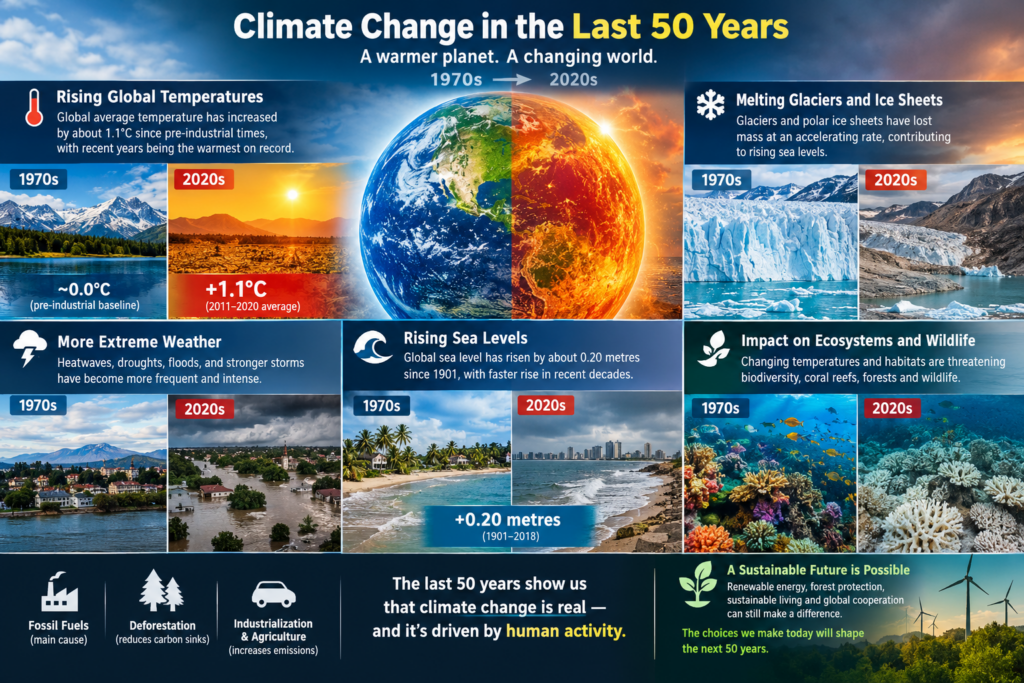
According to the Intergovernmental Panel on Climate Change (IPCC), global surface temperature in 2011–2020 was approximately 1.1°C higher than the average temperature during 1850–1900. Recent years have been exceptionally warm, and 2024 was confirmed by the World Meteorological Organization as the warmest year in the observational record at approximately 1.55°C above the pre-industrial average.
A single year’s temperature above 1.5°C does not mean that the long-term Paris Agreement temperature threshold has permanently been crossed. However, it demonstrates how quickly the climate is changing.
The increase in global temperature affects oceans, forests, agriculture, wildlife, and human health. Even a relatively small rise in average temperature can lead to major changes in weather patterns and natural systems.
2. Major Causes of Climate Change
Several human activities have contributed to climate change over the last 50 years.
Burning Fossil Fuels
Coal, oil, and natural gas are widely used to generate electricity, power vehicles, operate factories, and heat buildings. Burning these fuels releases carbon dioxide, a greenhouse gas that traps heat in the atmosphere.
As industrial development, transportation, and energy consumption have increased, greenhouse gas emissions have also risen. These emissions are the primary causes of modern global warming.
Deforestation
Forests absorb carbon dioxide from the atmosphere and help regulate the global climate. However, large areas of forests have been cleared for agriculture, urban development, mining, and infrastructure projects.
Deforestation releases more carbon dioxide and reduces the planet’s capacity to absorb future emissions. It also destroys wildlife habitats and disrupts the water cycle.
Industrialization and Agriculture
Factories, cement production, livestock farming, and the use of certain fertilizers release greenhouse gases such as methane and nitrous oxide. Population growth and rising consumption have increased demand for food, energy, housing, and manufactured goods, placing additional pressure on the environment.
3. Rising Temperatures and Extreme Weather
One of the most noticeable effects of climate change is the increase in extreme heat. Heatwaves have become more frequent and intense in many regions, creating serious risks for children, older people, outdoor workers, and people with existing health problems.
Climate change also influences rainfall patterns. Some regions experience prolonged droughts, while others face heavier rainfall and an increased risk of flooding. Warmer air can hold more moisture, which can contribute to intense rainfall when weather conditions are suitable.
Tropical cyclones and other storms are influenced by several factors, including ocean temperatures and atmospheric conditions. Climate change can increase the rainfall associated with some storms and intensify the strongest tropical cyclones, although changes in storm frequency vary by region.
These events can damage homes, roads, farms, and businesses. They can also displace communities, disrupt education, and create major economic losses.
4. Melting Glaciers and Rising Sea Levels
Over the past five decades, glaciers around the world have lost substantial amounts of ice. The Greenland and Antarctic ice sheets have also lost mass, contributing to rising sea levels.
Sea levels rise because melting land ice adds water to the oceans and warmer seawater expands. According to the IPCC, the global mean sea level rose by approximately 0.20 meters between 1901 and 2018, with the rate of rising acceleration in sea levels in recent decades.
Rising seas threaten coastal cities, islands, beaches, wetlands, and agricultural land. They also increase the risk of coastal flooding and saltwater entering freshwater supplies.
For countries such as India, coastal communities and major cities face growing risks from sea-level rise, storm surges, and coastal erosion. These challenges require better urban planning, protective infrastructure, and long-term adaptation strategies.
5. Effects on Wildlife and Natural Ecosystems
Climate change is altering natural habitats across the world. Many plants and animals depend on specific temperature ranges, seasonal patterns, and food sources. When these conditions change rapidly, some species struggle to survive.
Coral reefs are particularly vulnerable to rising ocean temperatures. Marine heatwaves can cause coral bleaching, which weakens coral ecosystems and threatens the many species that depend on them.
In mountain regions, rising temperatures are changing the distribution of plants and animals. Polar habitats are also being transformed as Arctic sea ice declines. Forests face additional risks from drought, pests, and wildfires.
Biodiversity loss can weaken ecosystems that provide essential services, including pollination, clean water, fertile soil, and carbon storage.
6. Climate Change and Its Impact on India
India is particularly vulnerable to climate change because of its large population, dependence on agriculture, extensive coastline, and varied geography.
Over recent decades, the country has experienced severe heatwaves, intense rainfall events, floods, droughts, and changing seasonal patterns. The effects differ from one region to another, and not every extreme weather event can be attributed solely to climate change.
The Himalayan region faces serious challenges. Rising temperatures are affecting glaciers, snow cover, and mountain ecosystems. Changes in snow and ice, together with shifting rainfall patterns, create risks for water resources and communities downstream.
Agriculture is also vulnerable. Higher temperatures and unpredictable rainfall can reduce crop yields, increase irrigation needs, and threaten the livelihoods of farmers. Heat stress can affect livestock, while extreme weather can damage crops and infrastructure.
Cities face additional challenges because roads, buildings, and other surfaces absorb and retain heat. Urban heat can make temperatures particularly dangerous during heatwaves.
Addressing these risks requires stronger early-warning systems, climate-resilient agriculture, improved water management, and sustainable urban development.
7. Solutions to Climate Change
Although climate change is a global challenge, practical solutions are available. Governments, businesses, communities, and individuals all have important roles to play.
First, renewable energy must expand. Solar, wind, and other low-carbon energy sources can reduce dependence on fossil fuels. Improving energy efficiency in buildings, industries, and transportation can also lower emissions.
Second, forests and ecosystems must be protected. Preventing deforestation, restoring degraded forests, protecting wetlands, and planting suitable native trees can support biodiversity and help store carbon.
Third, sustainable transportation should be encouraged. Public transport, walking, cycling, electric vehicles, and better urban planning can reduce emissions from travel.
Fourth, waste and consumption must be managed responsibly. Reducing food waste, reusing products, recycling materials, and choosing durable goods can lower environmental pressure.
Finally, governments must strengthen climate policies. International cooperation, investment in clean technology, climate finance, and support for vulnerable communities are essential to reducing emissions and preparing for unavoidable climate impacts.
Individuals can contribute by saving electricity, reducing unnecessary consumption, conserving water, and supporting environmentally responsible initiatives. Personal actions matter most when combined with wider changes in energy systems, infrastructure, and public policy.
Conclusion
The last 50 years have shown that climate change is no longer a distant possibility but an urgent global challenge. Rising temperatures, melting glaciers, increasing sea levels, ecosystem disruption, and extreme weather have demonstrated the consequences of a warming planet.
Human activities, particularly fossil fuel consumption and deforestation, are the main causes of the warming observed in recent decades. Without substantial reductions in greenhouse gas emissions, climate risks will continue to grow.
However, the future is not entirely predetermined. Investing in renewable energy, protecting forests, adopting sustainable practices, and strengthening international cooperation can help limit further warming and protect vulnerable communities.
Climate change is not only an environmental issue; it is also an economic, social, and public health challenge. The decisions made today will influence the quality of life for future generations. Protecting the planet requires collective responsibility, scientific understanding, and consistent action from every level of society.
The past 50 years have shown us how much the climate can change. The choices we make now will help determine what the next 50 years look like.