
Data centers are the hidden infrastructure behind Cloud storage, streaming, Online shopping, Banking and Artificial intelligence. Their servers process and store information around the clock, while cooling systems and backup equipment keep operations running reliably. As more services move online and AI workloads expand, the facilities’ environmental footprint is receiving greater attention.
The challenge is not simply that data centers use electricity and water. Their demands can grow quickly, and affect water supplies, power grids and surrounding communities. Addressing those impacts will require a combination of cleaner electricity, more efficient computing, careful management of water resources and transparent reporting.
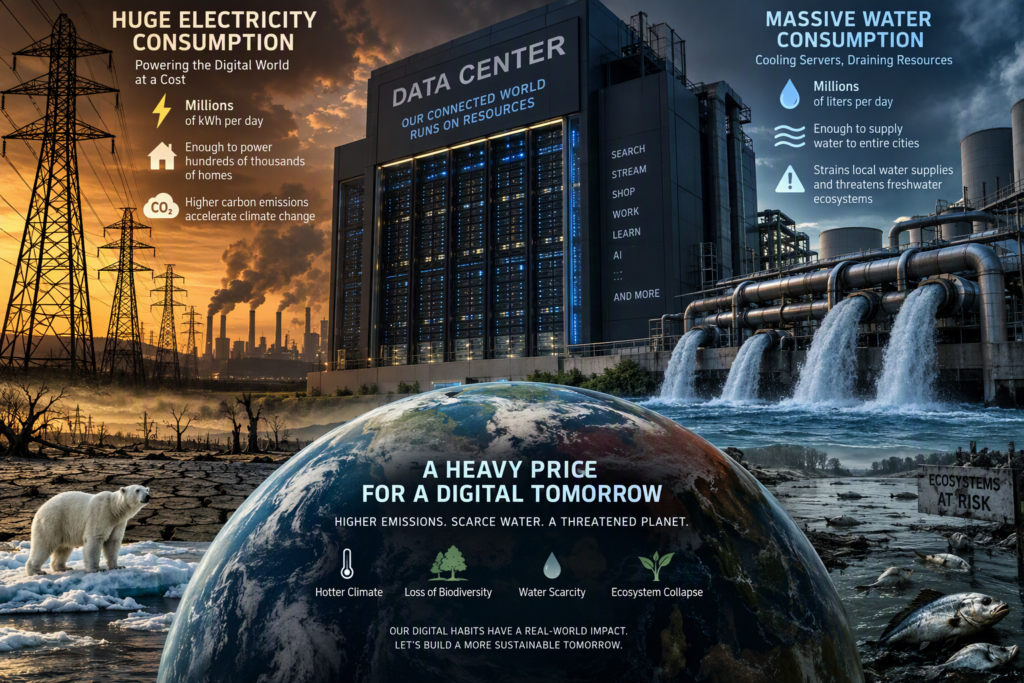
Rising electricity demand
Data centers draw power continuously. Servers do most of the computing, but cooling, power conversion, lighting and other facility systems add to the total. The International Energy Agency estimated that data centers used about 415 terawatt-hours of electricity worldwide in 2024—roughly 1.5% of global electricity consumption. In its central scenario, demand could rise to about 945 TWh by 2030, with AI among the factors driving growth. IEA, “Energy demand from AI”
A large Data Center facility often draw as much electricity as a town, city or district, and there may be several such facilities built in the same region. This can strain local grids, require new transmission lines and substations, and complicate plans to meet demand from homes, factories and transport. If new electricity demand is met by fossil-fuel generation, data center growth can also increase greenhouse gas emissions and air pollution.
The scale of future demand is uncertain. It depends on how quickly facilities are built, how much computing people use, and whether more efficient hardware and software can keep energy use in check. In the United States, a 2024 Lawrence Berkeley National Laboratory report estimated that data centers used 4.4% of the country’s electricity in 2023. It projected a wide range 6.7% to 12% by 2028—reflecting uncertainty about growth and efficiency improvements. Lawrence Berkeley National Laboratory, 2024 U.S. Data Center Energy Usage Report
Water, materials and local impacts
Many data centers use water to cool equipment, especially in systems that evaporate water to carry away heat. The amount varies by design, climate, workload and time of year. Water use can become a concern where supplies are scarce or communities already face competing demand. A facility’s water footprint also extends beyond its property: power plants that generate its electricity may consume water for cooling, and the manufacture of servers and chips requires energy and materials.
Cooling choices involve trade-offs. Air cooling can use less water but may require more electricity, depending on the climate and equipment. Liquid cooling can handle the heat from dense computing racks efficiently, but its water impact depends on how the system is designed and operated. A facility that reports low water use on site may still rely on electricity generated by water-intensive power plants. That is why assessments should consider both direct water consumption and the water used to produce electricity.
Data centers also create electronic waste. Servers, storage devices, batteries and networking equipment are replaced as workloads change or hardware ages. Mining and processing the metals used in electronics can damage ecosystems and consume energy. When discarded equipment is not reused, refurbished or responsibly recycled, valuable materials are lost and hazardous substances may enter the environment.
Other local effects include noise from cooling systems and backup generators, also air pollution by power backup diesel generators, land use, construction traffic and pressure on public infrastructure. These impacts are not the same everywhere: local grid capacity, water availability, energy sources and community needs all matter.
Solutions that address the full footprint
Improve computing efficiency. Operators can use newer, more efficient servers, consolidate lightly used systems and turn off or repurpose idle equipment. Software developers can reduce unnecessary computation, choose smaller models where they meet the need and optimize data storage and processing. Efficiency improvements matter because they reduce the electricity required for each unit of useful computing.
Use cleaner electricity around the clock. Buying renewable energy can help. A company can buy enough renewable electricity over a year. Data centers can make a stronger contribution by locating near clean generation, signing contracts that support new low-carbon projects, adding storage where cleaning energy is in abundant to decrease dependency on fuel generators as backups. Low-carbon sources can also help supply power when wind and solar output is low.
Reduce cooling and water impacts. Operators can improve airflow, prevent hot and cold air from mixing, raise safe operating temperatures and use free cooling when outdoor conditions allow. Where water is scarce, they can prioritize air-cooled or closed-loop systems, use reclaimed water where suitable and track consumption during droughts. The right design depends on local climate and water conditions.
Plan for location and grid capacity. Regulators and utilities can assess new facilities before approving them, weighing grid upgrades, clean power availability, water supply and community impacts. Developers can select sites with adequate infrastructure and avoid placing water-intensive facilities in stressed watersheds. Data centers can also provide grid services—such as adjusting flexible workloads or using batteries—to help manage peaks.
Extend equipment life and improve transparency. Repair, reuse and refurbishment can reduce the demand for new servers and the materials used to make them. Responsible recycling should recover valuable components and handle hazardous materials safely. Operators should report electricity use, emissions, water consumption, backup-generator use and hardware disposal in consistent, verifiable ways. Clear reporting allows communities, customers and policymakers to compare facilities and track progress.
Data centers support services that have become central to modern life, but their growth is not environmentally neutral. Better efficiency can slow the rise in demand; cleaner power can reduce emissions; thoughtful cooling and siting can ease pressure on water and communities; and reuse can limit electronic waste. The most effective approach treats energy, water, materials and local impacts as connected parts of one problem—and measures success by the services delivered with the least environmental harm.